
The Decade of Disney
Jan 02 2020
Last week, the Verge published an article announcing that, with the release of the latest Star Wars film, Disney had produced 80% of the top box office films in 2019. The general reaction was understandably quite negative, but this news was not particularly surprising as it was just the latest example of Disney as a definite media giant and possible monopoly holder.
Given the unprecedented and frankly somewhat scary implications of the Verge’s article, it’s worth exploring the meaning of and context around this 80% figure. This percentage reflects that Disney produced eight of the top ten highest grossing films in 2019, which they were able to secure once Star Wars: The Rise of Skywalker moved into the #10 spot after its big opening week (as of writing this, it has since moved up to the #6 spot). The seven other films included a mix of Marvel movies (Avengers: Endgame, Captain Marvel, Spider-Man: Far From Home), animated pictures (Toy Story 4, Frozen II), and remakes (The Lion King, Aladdin). The two non-Disney films were Joker and It Chapter Two, which came in at the #9 and #10 spots, respectively.
Beyond the number of top 10 movies that Disney produced, it is worth considering the share of total box office gross captured by the House of Mouse, especially since those at the top earn quite a bit more than the 9th or 10th biggest movies. Avengers: Endgame earned nearly 60% more at the box office than the 2nd highest grossing movie, which was also a Disney movie, and more than four times what It Chapter Two, the 10th highest, grossed. So when we look at the total box office revenue, Disney actually captured nearly 90% of the gross among top movies.
| # | Film | Domestic Box Office (as of Jan 1, 2020) | Share of Top Box Office |
|---|---|---|---|
| 1 | Avengers: Endgame | $858,373,000 | 19.7% |
| 2 | The Lion King | $543,638,043 | 12.5% |
| 3 | Toy Story 4 | $434,038,008 | 10.0% |
| 4 | Captain Marvel | $426,829,839 | 9.8% |
| 5 | Frozen II | $426,104,939 | 9.8% |
| 6 | Spider-Man: Far from Home | $390,532,085 | 9.0% |
| 7 | Star Wars: The Rise of Skywalker | $377,488,536 | 8.7% |
| 8 | Aladdin | $355,559,216 | 8.2% |
| 9 | Joker | $333,494,002 | 7.7% |
| 10 | It Chapter Two | $211,593,228 | 4.9% |
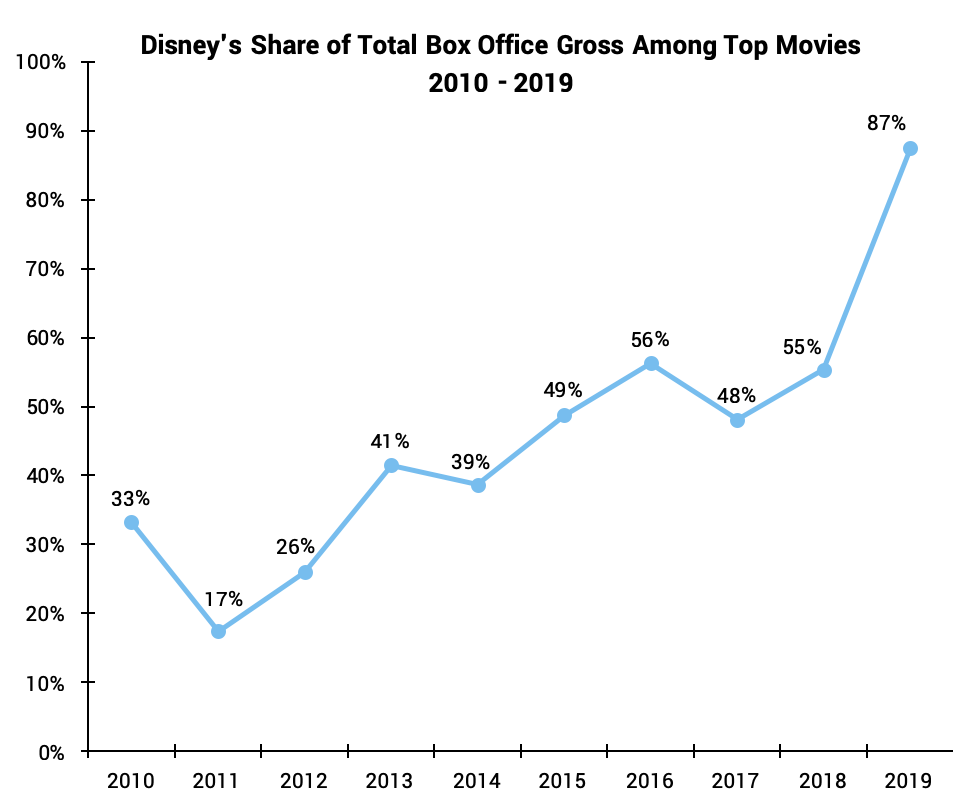
Top 50 Domestic Box Office Grosses for Movies Released Between 2010 and 2019
So what is there to be done about Disney? Should we even care? From a pure economics perspective, it feels like Disney is verging on attaining a somewhat obvious monopoly in the movie market, and as we all know, monopolies are bad! “But hold on,” you might say, “more Disney means more of my favorites from Marvel and Pixar!” And while I love Captain America, Buzz Lightyear, and the whole gang as much as the next guy, this kind of monopolistic hold from Disney has some severe implications for the quality of all the other non-Disney movies that I also love.
In the 1940s, after years of anti-competitive behavior on the part of major movie studios, the U.S. Supreme Court ruled to break up the “old Hollywood system” since it was seen to limit choice for consumers and in turn stifle the creativity of the industry. While the current Disney dilemma is structurally very different from the cases of the 1940s, the implications and detrimental effects on the film industry are quite similar. In a world captivated by giant superhero epics and blockbuster live-action remakes, there may be a diminishing opening for novelty, weirdness, and outside-the-box film-making, especially as original film concepts are becoming riskier and riskier in the era of streaming.
The film industry is a better place for the sake of (profitable!) movies like Knives Out, Ad Astra, and Booksmart. So while we wait for any actual government or industry intervention, I implore you to go see these kind of movies while you still can.
* * *
Methodology and minutia
Movie data (titles, domestic gross, and distributor) were pulled from Box Office Mojo on January 1, 2020. Box Office Mojo reports domestic gross for films back until 1977 so this analysis is limited to films released between 1977 and 2019. Movies were assigned year based on the year of their release date and total box office gross (including from years other than release year) was used.
Box office gross was not adjusted for inflation.
Movies were determined to be released by Disney based on the “Distributor” field from Box Office Mojo. However, Disney has earned money from films for which they are not distributor (examples include the latest Spider-Man films in their joint production deal with Sony). The Verge correctly considered Spider-Man: Far From Home as being produced by Marvel (and thus Disney) and thus counted the film in their analysis when stating eight out of ten films from 2019 were produced by Disney.